06/10/2026
Safety for the future
Two “Springer” on Industrial Safety of the Future
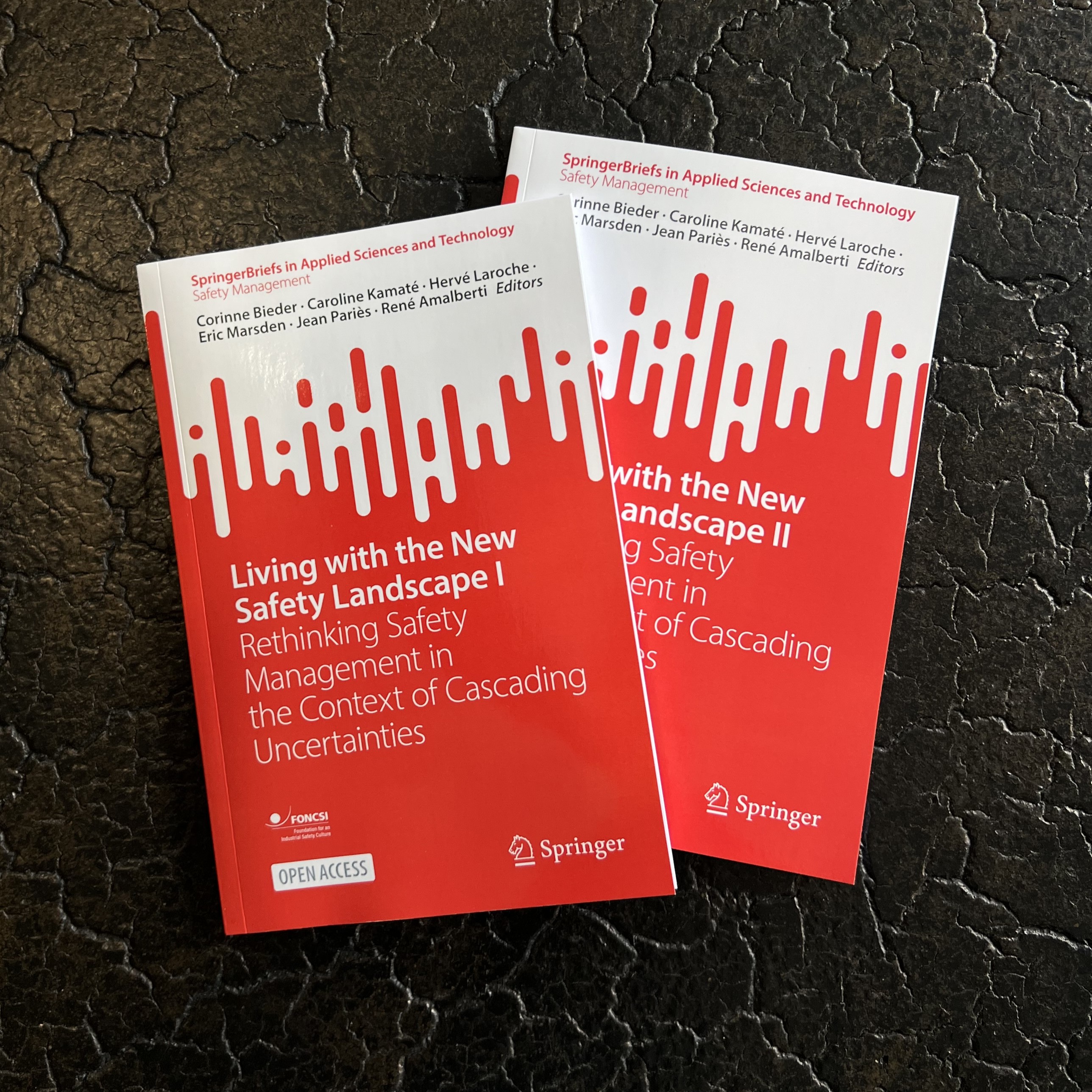
The Foncsi is publishing a new two-volume book in its open-access collection with Springer. Entitled “Living with the New Safety Landscape I & II,” these publications present, through twenty scientific articles, the results of four discussion workshops with international experts on the future of industrial safety.
In 2024 and 2025, the Foncsi regularly engaged with international experts on the “Cahier” Industrial Safety in the Age of “Living With”: Uncertainty, Complexity and Rising Expectations, which puts into perspective the major changes that have occurred since the end of the last century and their potential impacts on safety management, in relation to current safety models and practices.
These discussions led to the writing of scientific articles and the publication by the Foncsi of a new two-volume academic book in its open-access collection with Springer: Living with the New Safety Landscape I & II.
Read and download both volumes, available in open access:
What does “Living with” mean?
This English-language academic book provides a global overview of the many ways in which today's safety management and governance of high-risk industries may be destabilized in an evolving and rapidly transforming world. Rather than focusing exclusively on the traditional perimeter of safety management and governance, it considers industrial safety within a wider societal, technological, (geo)political, economic and environmental context to explore future challenges in the coupling of safety and its ecosystem and how to live with them.
The first volume
It analyzes the current situation as well as the destabilizations now underway and predicted to come in the future and suggests new frames of reference for this changing world, including:
- social contract;
- AI realism, and;
- the regulatory framework.
The second volume
It focuses on challenges at the organizational level before providing illustrations of ways forward implemented in various areas.
The articles and their authors
The two academic volumes comprise 20 chapters.
Living with the New Safety Landscape I
- “The Crumbling Facades of Industrial Safety”, from Corinne Bieder, Hervé Laroche and Éric Marsden (Foncsi, France)
- “Revitalizing Safety in Crisis”, from David D. Woods (The Ohio State University, United States)
- “Risk, Uncertainty, and Politics: The Need for a Critical Risk Science”, from Torgeir Kolstø Haavik, (NTNU, Norway), Stian Antonsen (Statnett, Norway) and Terje Aven (Stavanger University, Norway)
- “Toward New Risk and Safety Imaginaries”, from Jean-Christophe Le Coze (Ineris, France)
- “AI Gold Rush 2 Versus AI Realism: Overplaying Envisioned Benefits, Underplaying Real Risks”, from Michael F. Rayo, Dane A. Morey, David D. Woods (The Ohio State University, United States) and Tor Olav Grøtan (Sintef, Norway)
- “Toward a New Social Contract for Safety”, from Gudela Grote (ETH Zurich, Switzerland)
- “Risk Regulation at a Crossroads or Dead End? Ideas for the Road Ahead for Innovative and Sustainable Regulatory Approaches”, from Siri Wiig (Stavanger University, Norway) and Catherine Calderwood (University of Strathclyde, United-Kingdom)
- “Health and Safety in Precarious Work: Eroding Foundations of the Nordic Model of Labor Regulation”, from Ulla Forseth and Hilde Bjørkhaug (NTNU, Norway)
Living with the New Safety Landscape II
- “Lost in Representation: How Social Interaction Contributes to Safety”, from Petter Almklov (NTNU, norway) and Stian Antonsen (Statnett, Norway)
- “Living Safely with an Evolving Operational Environment”, from Tony Licu (Euro Control, France)
- “The Power of the Informal and Unspoken in Safety Practice”, from Jan Hayes and Sarah Maslen (RMIT University, Australia)
- “Hazards, Culture, and the Co-construction of Safety in Complex Organizations”, from Teemu Reiman (Lilikoi, Finland)
- “Suffocation by Management Systems. Why Deregulatory Chainsawing Will Fail to Reduce Administrative Burdens”, from Kristine Størkersen (Sintef, Norway) and Sidney Dekker (Griffith College, Australia)
- “How Can We Make AI Understand Safety?”, from Malakis Stathis (HCAA, Greece), Baumgartner Marc (IFATCA, Switzerland), Smoker Anthony (Lund University, Sweden) and Langejan Erwin (Luftfartstilsynet, Norway)
- “Supporting Excellence in Professional Practice in a Changing Industrial Landscape”, from Jan Hayes and Sarah Maslen (RMIT University, Australia)
- “Health Care in Crisis: Prospects and Directions”, from René Amalberti (Foncsi, France), Siri Wiig (Stavanger University, Norway) and Charles Vincent (University of Oxford, United Kingdom)
- “Lost in Sustainability? What Happens to Road Safety When Integrated in the Broader Sustainability Agenda?”, from Tor-Olav Nævestad (Institute of Transport Economics, Norway) and Hanna Wennberg (Lund University, Sweden)
- “Artificial Intelligence in the Skies: Reconciling European Regulation and Liability in Aviation”, from Federico Franchina (The University of Messina, Italy)
- “AI and Offshore Safety Management”, from Ole Andreas Engen and Preben Hempel Lindøe (Stavanger University, Norway)
- “Regimes of Fractured Objectivity: On the Limits of Technological Risk Governance”, from John Downer (University of Bristol, United Kingdom)
An internationally renowned academic collection
Since 2016, the Foncsi has published an open-access collection with scientific publisher Springer. These two volumes are the 20th and 21st books published by the Foncsi with Springer in its “SpringerBriefs in Safety Management” collection.
Discover the “SpringerBriefs in Safety Management” collection